
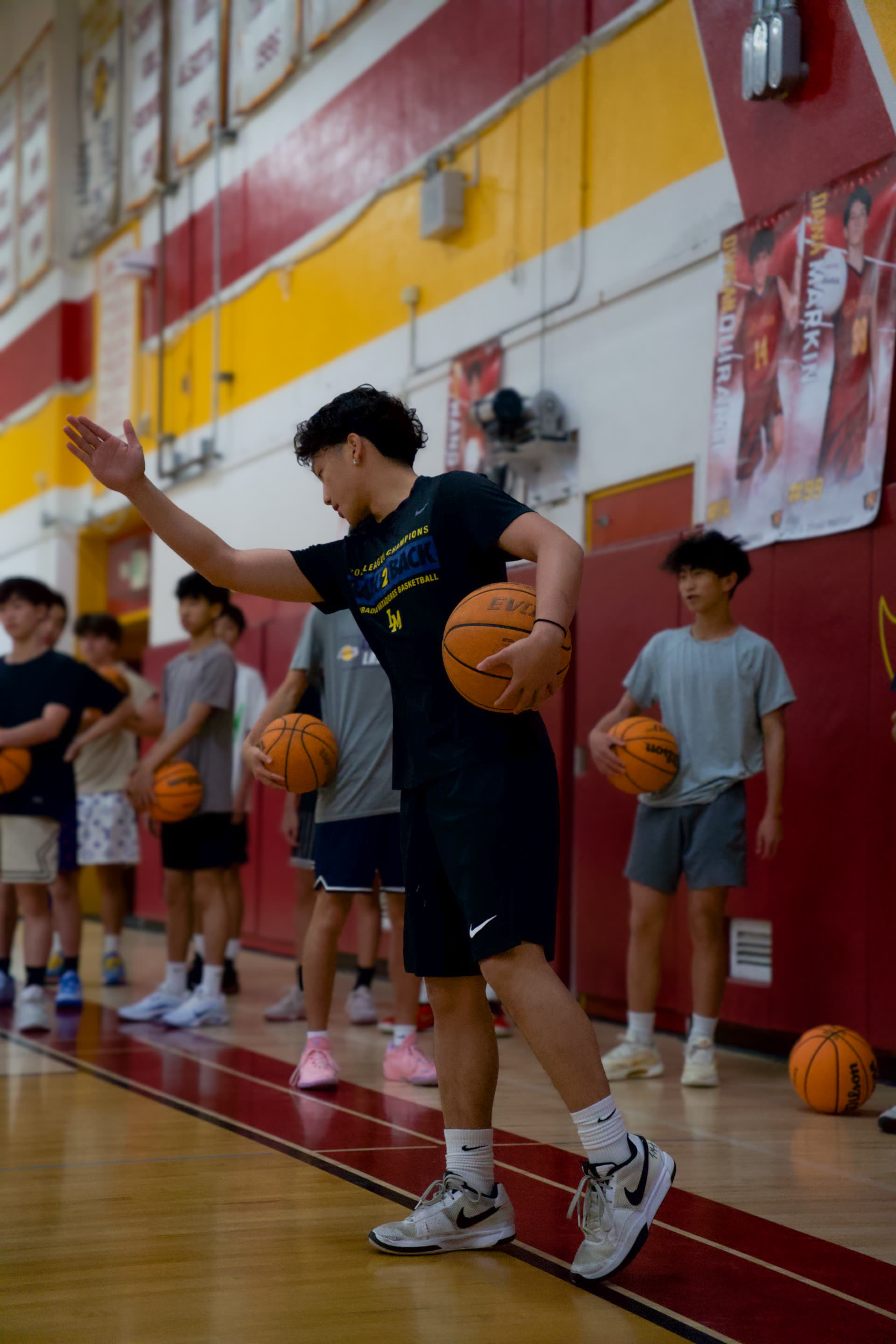
How it works
-
1
Step one
Book a free trial
Fill out one short form. Ethan texts you within 24 hours with times that work for your family.
-
2
Step two
Attend the trial
A real no-pressure hour on court, not an evaluation. Parents are encouraged to stay and watch the whole thing.
-
3
Step three
Select a plan
If it's a fit, pick the membership that matches your schedule and goals, and the work begins.
Typical training vs. ShigHoops
Most trainers
- ✕Same warm-up and drill block for every player
- ✕Cone patterns with no defender to read
- ✕Reps counted, progress assumed
- ✕Looks impressive on Instagram
- ✕Skills fade the moment the game starts
The ShigHoops session
- ✓Plan built around one player's actual gap
- ✓Live reads, constraints and decisions in every block
- ✓Adjusted mid-session based on what's happening
- ✓Take-home drills so the week between counts
- ✓Built for in-game transfer
Train the decision, not the routine.
Skill acquisition research is clear on one thing: how you practice decides whether the skill survives contact with a real game. Five principles shape every hour on the court.
-
01
Representative practice
If a rep doesn't look like the game, it doesn't prepare you for the game. Drills carry the information a player actually reads: a defender's hips, a closing angle, a shrinking window.
-
02
Constraints over commands
Rather than dictating one "correct" technique, we change the task so the right solution emerges. Players own movement that fits their body instead of copying someone else's.
-
03
Desirable difficulty
Practice that feels a little messy produces learning that lasts. Sessions sit at the edge of a player's ability, never in their comfort zone.
-
04
Variability, not repetition
Blocked reps build a groove that breaks under pressure. Varied, interleaved reps build a player who can solve a situation they've never seen before.
-
05
Transfer is the only metric
Looking good in training is not the goal. The measure of a session is what shows up on game day.
Frequently asked
What ages and levels do you train?+
There are currently two age brackets: a middle school group (5th through 8th grade) and a high school group.
Where are sessions held?+
All training takes place at PTBA, located at 16101 Old Valley Blvd, La Puente, CA 91744.
Private sessions or group only?+
I offer both. Group sessions are the standard format, but I do keep a limited number of slots open for private, one-on-one training.
Can I pay per session instead of a package?+
Yes. Packages are discounted and generally produce better progress because of the consistency, but session-by-session is available.
Are there sibling or group discounts?+
Yes. Siblings and group sign-ups get discounted rates when they book a shared package of sessions. Text 626-277-1819 for a quote.
Still have questions? Text 626-277-1819 or email ethan@shighoops.com.