Our evidence-based training philosophy

Core Approach: Constraints-Led Approach (CLA)

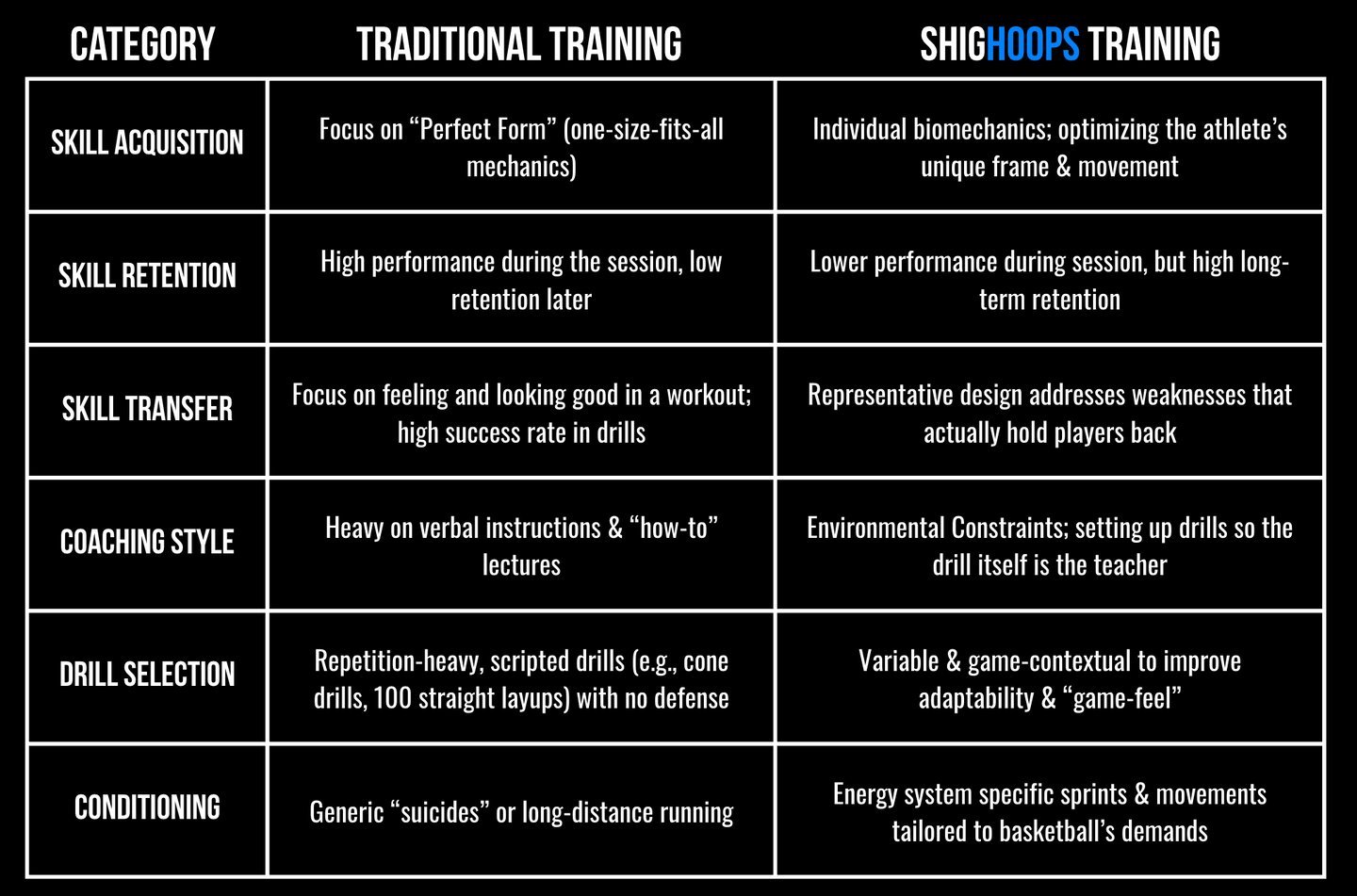
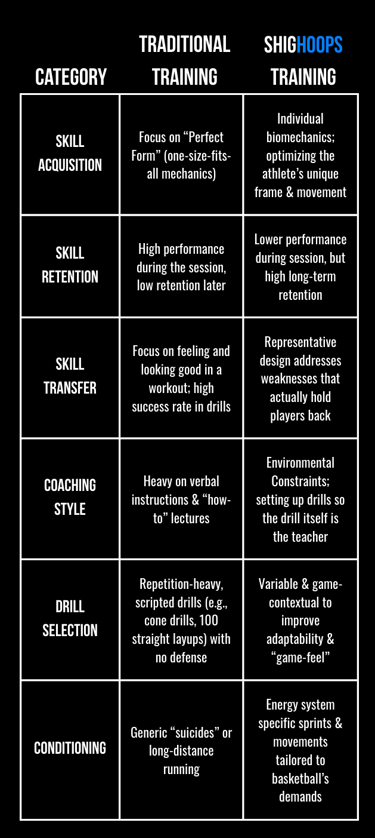
The constraints-led approach (CLA) manipulates task, environmental, and individual constraints—like space, rules, or equipment—to guide players toward self-discovering effective solutions. Instead of direct instructions, we set up drills where players adapt movements based on interactions, fostering smarter, game-ready decision-makers.

Functional Movement Variability

Functional movement variability encourages slight, natural fluctuations in technique during practice to expand a player's motor workspace. This builds resilience to game disruptions, like varying defender pressure, allowing consistent performance across contexts without rigid patterns.

Building Adaptability

Adaptability is central, spanning multiple dimensions trained through variable, contextual drills.

  • Movement adaptability: Players adjust biomechanics dynamically to perturbations, such as bumps or angle changes.​

  • Skill adaptability: Techniques evolve with task demands, like varying shot arcs or footwork.​

  • Tactical adaptability: Quick shifts in strategy, such as defensive switches or offensive spacing adjustments.​

  • Psychological adaptability: Managing stress and errors via mental toughness and recovery techniques.​

  • Social adaptability: Responding to teammates' or opponents' actions, like post-error caution in team settings.​

Perception-Action Coupling

Perception-action coupling links what players see and feel directly to their movements, ensuring decisions emerge from real-time environmental cues rather than isolated skills. We train this in dynamic scenarios to mirror game split-second choices.​

Information Processing Theory vs. Ecological Dynamics

Traditional information processing theory views learning as cognitive steps (perceive, decide, act), while ecological dynamics emphasizes emergent behavior from player-environment interactions. We favor ecological dynamics for its superior transfer to chaotic games over rigid cognitive models.​

Blocked vs. Random Practice

Blocked practice repeats one skill in isolation for quick mastery, but random practice interleaves varied skills for better retention and adaptability. Our sessions shift to random early, using game-like sequences over drills.​

Practice Variability

Practice variability introduces changes in distance, speed, angles, or equipment to challenge problem-solving. This boosts engagement, skill transfer, and robustness compared to repetitive drills.

Repetition Without Repetition

Repetition without repetition means performing similar actions with subtle variations, avoiding identical rote reps. This promotes flexible motor control attuned to basketball's dynamic nature.

Differential Learning

Differential learning amplifies random perturbations in practice to enhance skill acquisition and creativity. Studies show it improves shooting accuracy and adaptability in youth players over traditional methods.​​

Small-Sided Games

Small-sided games (e.g., 2v2, 3v3) replicate game demands in condensed formats, boosting aerobic capacity, decision-making, and skills like shooting with more involvement than full-court play.

External vs. Internal Cues

External cues focus on environmental effects ("push the rim back"), outperforming internal cues ("bend your knees") for better performance and fluidity. We use them to reduce overthinking.

Guided Discovery

Guided discovery employs constrained defenses or scenarios to prompt self-exploration without prescribing solutions. This accelerates learning in small-sided games by streamlining trial-and-error.​

Representative Learning Design

Representative learning design crafts practices mirroring competition demands in rules, space, and pressure. High representativeness ensures skills transfer directly to games.​

We base our basketball training on modern, research-supported principles from ecological dynamics and motor learning science. Unlike the traditional basketball training that players typically experience, these methods prioritize adaptability, game-like practice, and self-discovery over rote repetition, helping players perform better under pressure. Below are some of the concepts drawn from established coaching frameworks proven in basketball contexts.